Wind, Water, and Needle: The Luopan and Feng Shui
PRIMITIVE - Tuesday, October 06, 2026By Glen Joffe

|
| Luopan; Primitive I.D. A2600-047 |
Long before the compass guided a ship, it pointed to “home.” In the context of Feng Shui, the Chinese art of placing objects to harmonize with the environment, home meant the correct site for a family home or any other important building, resting places for deceased ancestors such as tombs and graves, and the site and placement for an entire city or community.
For more than two thousand years, Chinese builders, families, and emperors used Feng Shui to decide where and when to build, and how whatever was being built would be situated. In imperial China, Feng Shui sat inside what counted as natural knowledge, alongside astronomy, calendrics, and cartography. Its practice also produced real science: the magnetic compass, one of the world’s great scientific instruments. Yet, Feng Shui is much more art than science, and although it has been called the science of place it can be accurately described as the Chinese art of placement.
Feng Shui means "wind and water." Its practice rests on a single premise: Qi, the living breath of the earth, scatters on the wind and gathers where it meets water. A house, tomb, or city placed where Qi pools will bring health, prosperity, and peace to those who live and rest there. A site placed poorly will invite the opposite. Its founding idea comes from the Zangshu, the Book of Burial attributed to the fourth-century scholar Guo Pu.
Two traditions grew from Feng Shui’s original premise. Each examined and emphasized different aspects of the hypothesis. First, the “Form School,” rooted in the mountains of Jiangxi Province, read the land itself: the curl of a ridge, the bend of a river, the hills that shelter a site from behind like the back of a chair. Second, the “Compass School,” which flourished in Fujian Province, read direction and time: the movement of the stars, the seasons, and the cycles of yin and yang. Historically, most practitioners fused the two schools.
 |
|
In practice, followers of the Form School needed only an eye to determine the “right site,” whereas those aligned with the Compass School required an instrument to read direction. Enter the Luopan, the Geomancer or Feng Shui master’s compass. Born for divination as opposed to navigation, a magnetic needle sits at the center of the compass. Around it, moving outward from the center like ripples in water, sit ring after ring to help determine where to build, which way to face, and when to begin. The inner rings place a site in the cosmos, middle rings delineate direction, and outer rings establish exact angle in relation to the stars and the calendar. The rings can be viewed as a web meant to catch all relevant information caught between heaven and earth, and to bring it to bear on a single point of ground.
Luopan translates as net plate. It has also been called “The Net That Holds the Sky.” At the center of the Luopan sits the tianchi, the Heaven Pool: a small well holding the compass needle above a fine red line. The geomancer turns the dial until needle and line agree, then reads outward, ring by ring. A simple Luopan carries a handful of rings. A master's instrument may carry forty or more.
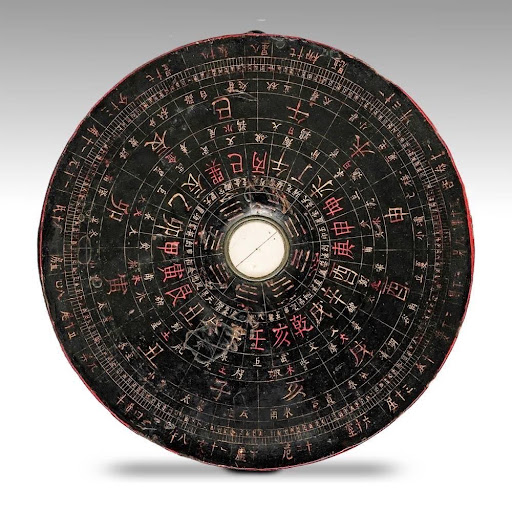
Among the Luopan's oldest and most characteristic features are eight trigrams called the bagua. The eight trigrams are every possible combination of three stacked lines, each line being either solid (yang) or broken (yin). They are read from the bottom up, and each one stands for a force of nature, a particular quality related to personality or the environment, and a specific family member, which is relevant when Feng Shui considers the placement and organization of family homes. The trigrams form the building blocks of the I Ching, one of the oldest divination systems in the world. Look at Primitive’s Luopan numbered A2600-047 and upon examination you can see the eight trigrams closest to and surrounding the central Heaven Pool. Traditionally, the bagua were placed near the center as they provided the most fundamental framework on the dial, and every ring further out elaborated on them.
 |
|
As important as the trigrams may be, all Luopan feature an essential ring called the Twenty-Four Mountains. The Twenty-Four Mountains is the ring that divides the full circle of the horizon into twenty-four equal slices of 15 degrees each. Each slice has a name. In Feng Shui, the back of a structure is its “mountain.” The front is its “facing.” Any of the twenty-four directions can be the one a structure has its back against. Each is called a mountain. Every reading starts here: the sitting mountain fixes the facing direction, and the rest of the dial adjusts the placement. Together the Twenty-Four Mountains form the Luopan's basic map of direction. A compass is useful to the degree it can name what it shows. The Twenty-Four Mountains is the naming system. When a geomancer records which way a structure will face, he names one of these twenty-four directions. Every other ring on the dial is used to interpret and add nuance to the placement. Without the Twenty-Four Mountains ring, the rest of the Luopan provides information that cannot be applied. Consequently, the Twenty-Four Mountains is the one ring found on every Luopan.
Primitive’s number A2600-044 shows the classic order. Around the needle lie the eight trigrams. Beyond them, in bold red and gold characters, run the Twenty-Four Mountains. Further out, gold characters mark the Twenty-Eight Lunar Mansions, the ancient Chinese division of the night sky, each with its span of degrees counted out along the rim. In this example, compass, earth, and constellation share one face.
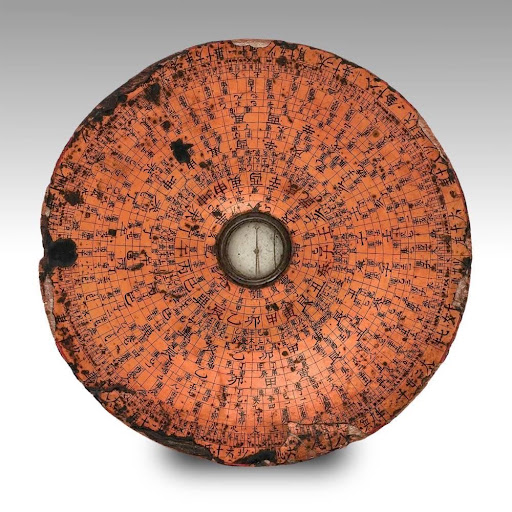
Primitive’s number A2600-048, an early instrument, only shows the Twenty-Four Mountains laid down three times, each slightly offset from the others. This configuration is called the Three Plates - Earth, Man, and Heaven. The first plate, Earth, observes what brings Qi to the site and provides the site’s sitting direction. The second plate, Man, observes the contours of the land that shelter or threaten a site to help adjust placement. The third plate, Heaven, observes where water enters and leaves the site. Remember, Qi gathers where it meets water. Thus, one reading of a site gives three slightly different answers, each suited to a different feature of the landscape. It is up to the geomancer to weigh them and perfect the actual placement to maximize its Qi.
These illustrations show that there was no standardized format for Luopan. Different workshops flourished in old China and each produced their own versions of instruments based upon which compass school of Feng Shui they served. Different versions were also tempered by the physical region where the workshop was situated, and by the sizes and finishes any individual workshop favored.
Ultimately, three styles of Luopan emerged. The first style followed the “landform and water” system favored by the Three Harmonies School. These Luopan carried all three plates, as in A2600-048. They were primarily concerned with direction. The second style followed the time-based “Flying Star” system favored by the Three Cycles School. These Luopan featured the 64 hexagrams of the I Ching in lieu of the three plates. This system suggested the nature of a structure could shift according to its facing direction, construction date, and the cycles of the Chinese calendar. It measured changes in the environment over time. The third style combined both systems into one comprehensive face. Known as Zong He, or “comprehensive” Luopan, the rings of both major Compass School systems appeared on one face. With Zong He Luopan, a practitioner could use either method or check one against the other without carrying two instruments. Combined Luopan were usually large and densely ringed. Still, beyond the three major types, other types of Luopan were created. Some were extremely simple with just a few rings, while others featured “private dials” made for a single lineage of masters.
In old China, the Luopan never worked alone. It was the major tool in the Feng Shui master’s arsenal. The Lu Ban ruler, named for the patron saint of carpenters, measured doors, altars, and coffins. Its scale is divided into eight sections: wealth, illness, separation, righteousness, office, robbery, harm, and origin. A carpenter cut to the fortunate marks and avoided the rest. The Tong Shu, the Chinese almanac, set dates for construction. A well-placed door built on the wrong date was a well-placed mistake. The bagua mirror, hung above an entrance, turned bad influence back on itself. Taken together, all the tools answered the three questions of feng shui: where, which way, and when. Yet, the answer to all these questions began with the Luopan.
Luopans are not decorative pieces that happen to be old. Regardless of when they were created, they are working instruments – and the good ones show their work. Features like the foxed and spotted surfaces along with distressed patinas, losses along rims, characters softened by years of caressing fingers and thumbs, even dislocated or missing needles, illustrate multiple readings recorded at hillsides, rivers and streams, in valleys and on steep slopes, in open fields with only the horizon as company - too many environments and situations to mention. A well-worn Luopan stood at the center of decisions families lived with for generations. It answered questions like where to build, which way to face, and where to lay a father to rest. The needle settled, the master read the rings, and the land answered. Today, the needle still settles. Hold one in your hands and it will turn and tremble, but it will always point to home.