Natural Abstraction: Chris Hurd and the Earth From Above
PRIMITIVE - Wednesday, October 14, 2026By Glen Joffe
Long before any painter made a non-objective mark on canvas, the Earth was making abstract art. Rivers braided silt into ribbons of ochre and slate. Wind and water combed black sand into rhythmic ridges. Minerals stained the ground in colors no studio would dare to mix. And against this massive color wheel an infinite number of shapes were laid ranging from the purely amorphous to hard edged geometric forms. For most of history these works went unseen. They weren’t hidden; they simply lay outside the line of human sight.
The idea that Earth is an artist has deep roots. For centuries, Chinese scholars collected natural slabs of metamorphic limestone mined from the Cangshan mountain range near Dali in Yunnan Province. Called “Dream Stones,” the natural mineral striations mimicked traditional East Asian ink-wash paintings featuring landscapes and clouds. These slabs were cut, framed, and treated exactly as human-made paintings because their veining already read as mountain and mist. You might characterize them as paintings by artist Earth as opposed to their human-made counterparts.
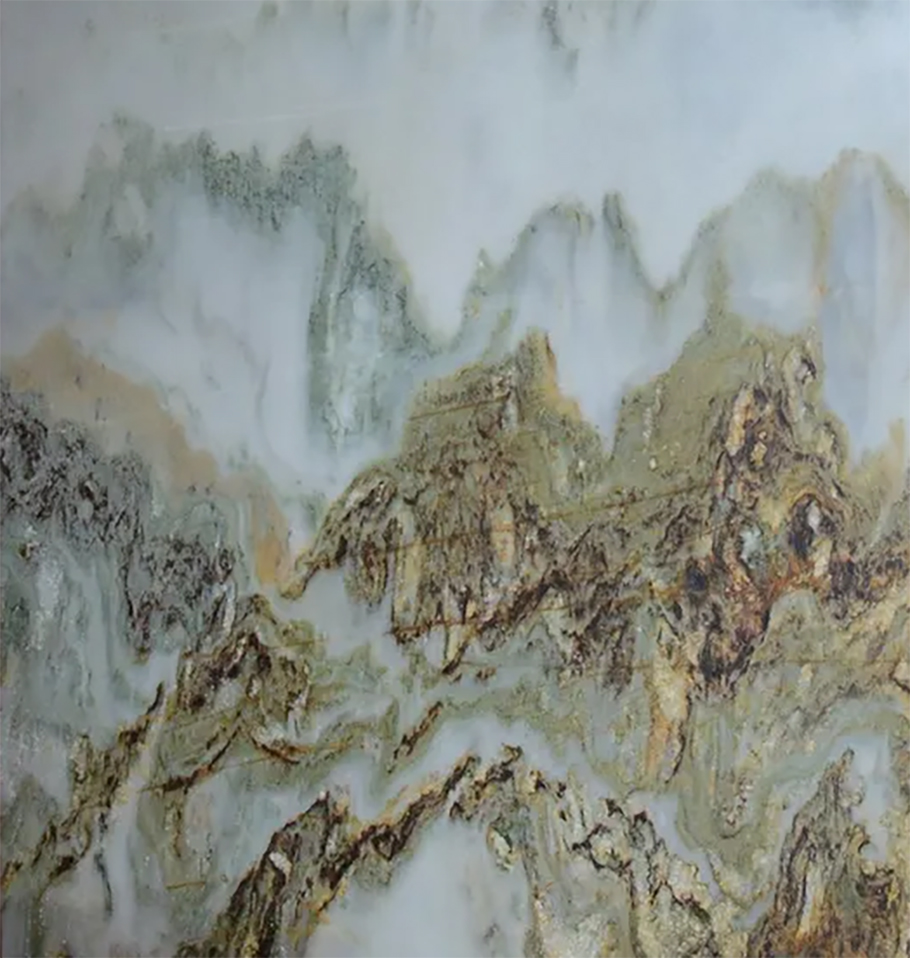
Example of Dali “Dream Stone”
When it comes to modern art, the tables were turned. The natural landscape became the inspiration for artists who interpreted it in their own way. Georgia O’Keeffe, went into the clouds in her seventies, completely shifting her perspective by looking through airplane windows. She captured sweeping, simplified abstractions of the earth and sky from above and turned them into some of her boldest late canvases. And when Hans Hofmann urged Jackson Pollock to paint from nature, Pollock answered, “I am nature,” perhaps because nature lays down lines by motion rather than intent, which was precisely Pollock’s methodology. Always though, the human artist’s hands were taking cues and inspiration from artist Earth.
Chicago photographer Chris Hurd began looking for Natural Abstraction in 2016 on a trip to Iceland. The trip became an annual pilgrimage, and the island’s raw terrain became his subject. Looking down on glacial rivers, lava fields, and meltwater plains, rivers carrying fine “glacial flour” turned waters a milky turquoise or silt-brown. When darker water entered the picture, colors began to bleed until they resembled feather-like stained canvases by Helen Frankenthaler. Seen from great heights, mineral-rich volcanic rock produced bands of rust, ochre, green,
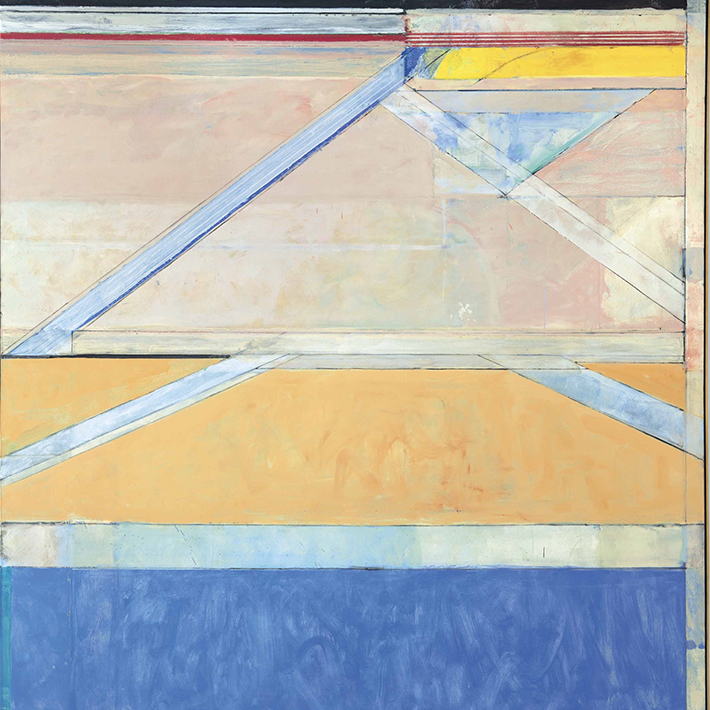
Image from Richard Diebenkorn “Ocean Park” Series
and pale gold. They became broad fields of color in the manner of Richard Diebenkorn, who said flying over the Southwest in the early 1950s showed him the landscape as flat pattern. It was the view from the plane that shaped his move into abstraction. A painter learning abstraction from an airplane window is very close to what Hurd does with a camera. The natural abstractions produced by the earth are not the starting point of Hurd’s work. It is the point. Hurd discovered the original source of inspiration for some of the world’s most noteworthy artists and placed their peer – artist Earth - on an equally elevated plane.
Looking down on a landscape, both the horizon and a sense of scale fall away. Hurd’s approach allows him to focus on a single plot of land, isolating it against the context of its vast surroundings. Natural rather than artificial light draws out texture and color. What remains is pure composition – line, shape, color, texture, and tone - rendered by Earth, but viewed and tempered by the human eye and hand. So painterly are Hurd’s photographs, in most instances it would be easy to mistake them for works on canvas.
_07096.webp?updated=undefined)
A flock of birds flies above an Icelandic landscape
Nonetheless, an occasional clue can be found proving Hurd’s subject is real rather than imagined. In one aerial view taken in Iceland, a flock of birds can be seen floating above organic bands of rust, white, grey, and black. They disrupt the sense that the terrain was painted by brush rather than natural processes.
Chris Hurd’s work can be called Natural Abstraction. It illuminates artist Earth’s versatility. Using only the natural medium, artist Earth puts forth a wide array of styles. Hurd’s photographs chronicle the abstract and close the gap between realism and abstraction. They remind us that abstraction did not begin as a rebellion against the natural world. It began as a way of seeing it. His images return us to the source: the world’s greatest living artist, still at work, still inspiring those willing to look, and still exhibiting in some of the world’s hardest to reach places.
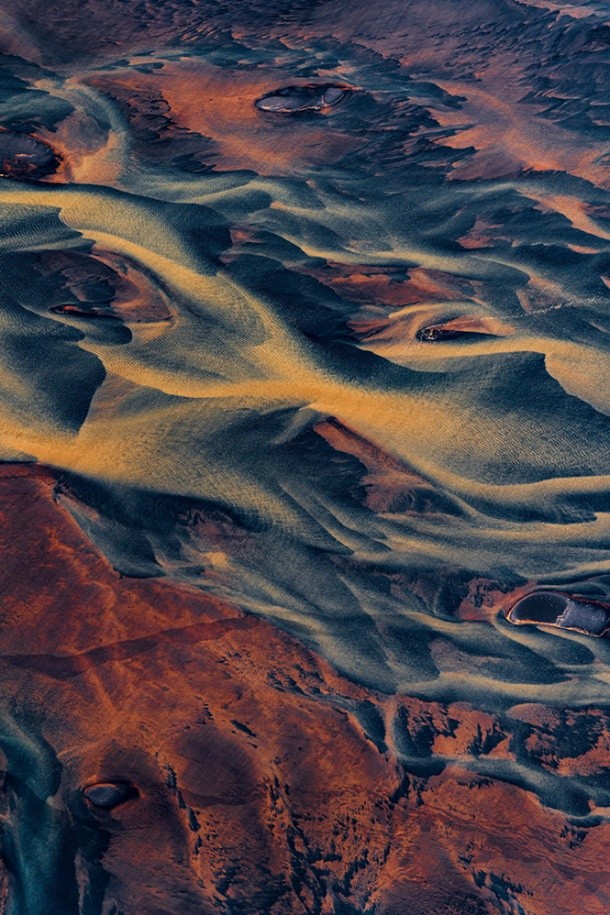
Meltwater braids across volcanic sand, laying down gold and slate in strokes no hand could plan