Sanity & Madness: The Paintings of Gail Potocki
PRIMITIVE - Tuesday, October 27, 2026By Glen Joffe
 |
|
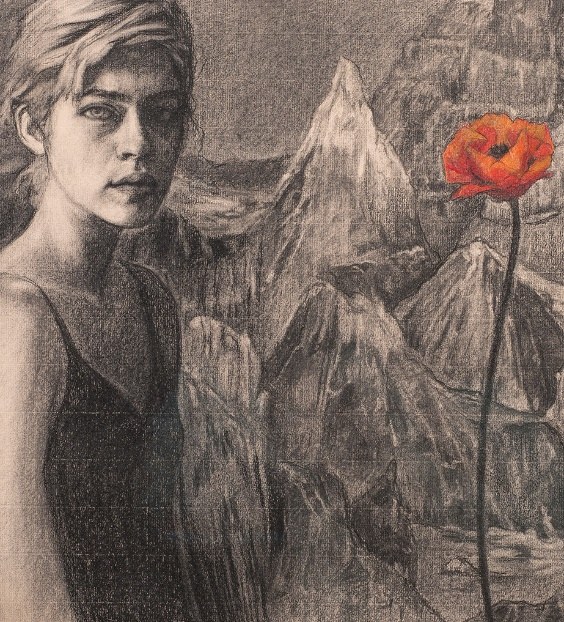
Dissect a Gail Potocki painting and you’ll discover it has been built twice. First comes the sanity: a drawing, typically worked out at full scale, line by line, until the composition carries the eye exactly where she wants it to go. Potocki is a master of gaze motion, the concept of using visual components to lead the eye through an image. Her drawings are full-fledged artworks preceding what finally appears on canvas, and what appears - the imagery - is the madness.
Potocki presents us with a world in which beauty and unease coexist. Classically trained, she applies the techniques of the Old Masters to current subjects like the environment, human transformation, humanity’s complicated relationship with the natural world, mortality, captivity, confinement, dreams, and consciousness. Huffington Post described her work as “Art that explores mankind’s relationship to nature.” But it is more than that.
 |
|
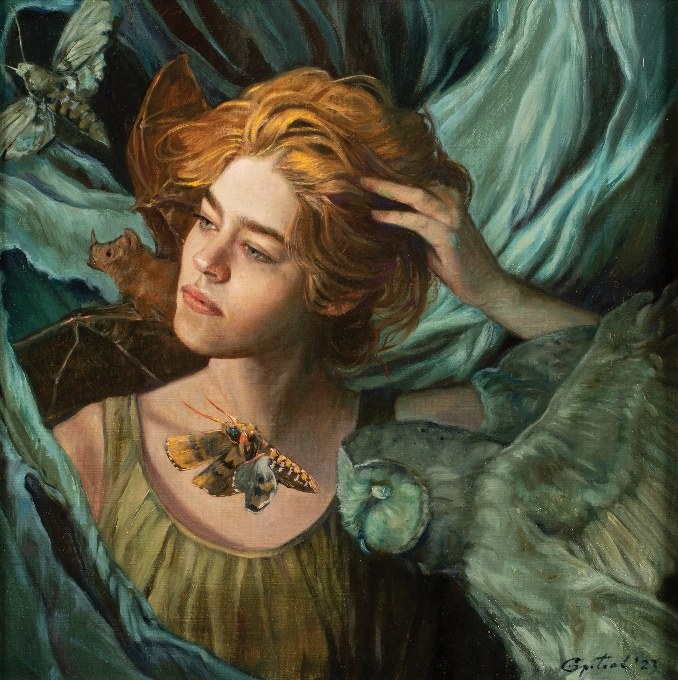
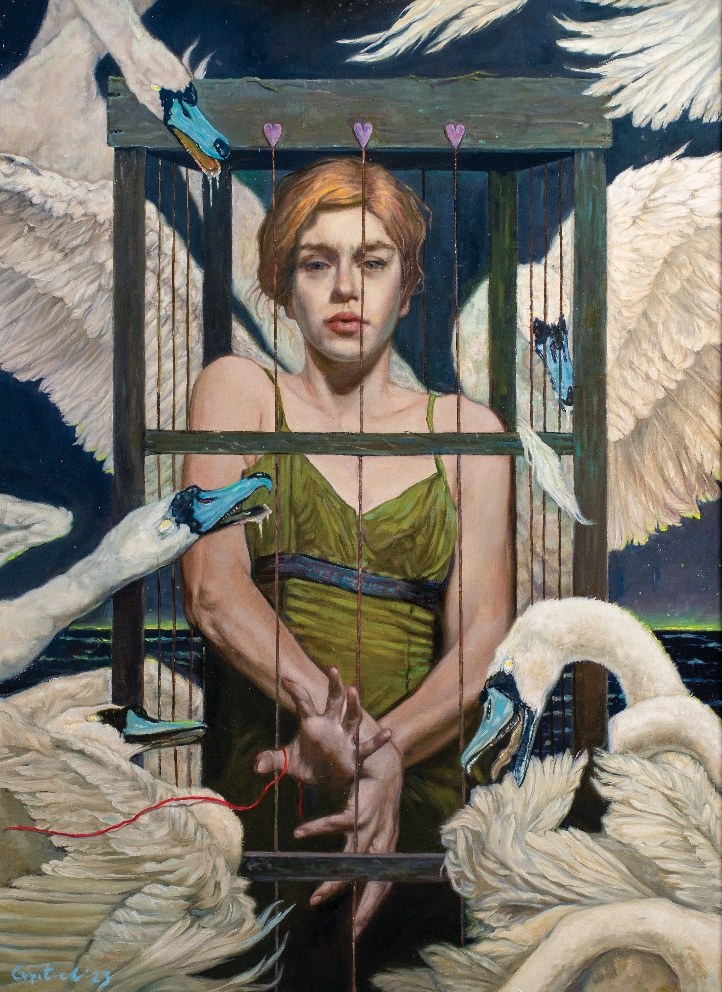
Her paintings are filled with symbols, many of them reflecting the natural world. Birds, insects, land animals, flowers, and plant life are regular features, but so are all manner of inanimate objects along with human adornment. They all find a place in her canvases, which she judiciously edits to create a story that is inevitably felt before it can be understood. Frequently, the storyteller is a young woman. She is attractive enough to draw the viewer into the scene, and we, like her, become enmeshed in a lush, semi-surreal world laced with mystery, sensuality, and drama. We become part of the story. At first glance, many of her works appear dark in terms of palette and mood, but these paintings are never simply sad. They are secret, and as viewers, it is up to us to uncover the hidden meanings they conceal.
The subject matter of Potocki’s paintings is not straightforward. She does not depict scenes featuring people, but rather, people set within carefully calculated scenes populated by a host of symbols. Even the landscape, whether appearing as a backdrop or feature element, becomes another symbol, and when it is absent, as in her portraits, another sort of symbol becomes prominent. Potocki’s portraits are as much about the atmosphere and the aura surrounding her subjects as they are stunningly faithful renditions of a posing individual. In her world, the subject of the portrait is a symbol too.
 |
|
Potocki works in the tradition of nineteenth-century Symbolism, which took shape in France and Belgium in the 1880s as a revolt against Realism and Impressionism. Whereas those movements painted what the eye could see, Symbolists aimed to depict what the eye could not: dreams, hidden emotions like dread and desire, even the fabric of the soul. They believed images could carry meaning just as music does, and that emotional impact preceded rational interpretation. Artists like Gustave Moreau, Odilon Redon, and Fernand Khnopff built an entire vocabulary around myth, mystery and melancholy amidst their feeling that European civilization was declining. Potocki inherited that vocabulary. Her enigmatic female, animals as emissaries of a bigger unseen world, every element laced with hidden meaning, and beauty accompanied by decay as opposed to renewal, harken back to the Symbolists.
Yet there is one big difference between Symbolism as it developed in the nineteenth century and Potocki’s unique contemporized version: direction. The original Symbolists turned inward and away from the modern world. They cocooned the individual as a safeguard against societal decline and viewed the soul as a solitary entity to be sheltered from a vulgar modern world. The soul was the real subject of Symbolist art; the visible world was only its surface. If Symbolism had a mantra, it was “look inward.”
Potocki looks the other way, using the language of Symbolism to gaze outward. Her paintings ask us to explore our relationship with the outside world, to see how myth and modernity are connected. She takes the nineteenth-century language of inner life and turns it towards twenty-first century crises. Viewers are forced to confront these crises, whether they be personal or societal, homebound or international. There is no hiding. The question of responsibility is rarely settled, for viewers may see themselves as victims, saviors, or accomplices in any interpretation they land upon. Potocki describes her work as balancing on the edge between beauty and devastation. It is there, on that edge, that the tension between Sanity & Madness is found.
______________________________
Gail Potocki’s work can be seen in numerous notable private collections including that of filmmaker Guillermo del Toro, and has been hung at the Los Angeles County Museum of Art, the Minneapolis Institute of Art, the Art Gallery of Ontario, the Laguna Art Museum, and the H.R. Giger Museum in Switzerland.
A selection of Gail Potocki’s paintings can be seen one day only at the pop-up exhibition, Sanity & Madness, on Halloween, Saturday, October 31 from noon to 5 p.m. in the Five Elements Library at Primitive, 130 N Jefferson St. in Chicago. It is a rare chance to view her works in person.